“When you’ve got four hundred quarts of greens and gumbo soup canned for the winter, nobody can push you around or tell you what to say or do,” civil rights activist Fannie Lou Hamer famously observed. Hamer, who founded the Freedom Farm Cooperative in 1967 to empower Black farmers in Mississippi, was a persistent voice arguing for the link between food and power. She viewed food security, the ability to reliably access healthy foods, as a requirement for achieving racial and economic liberation for Black people.
Today, a growing food justice movement in the United States is engaged in tackling inequities in the American food system. This project focuses on one food justice organization, the Black Church Food Security Network (BCFSN), founded in Baltimore City in 2015. Like other food justice groups, the BCFSN believes that structural socioeconomic and racial inequalities in American society are the root causes of food insecurity. However, the BCFSN also draws on intellectual elements of the Black radical tradition and the solutions it has developed, much like Fannie Lou Hamer’s Freedom Farm, prioritize autonomy and self-determination for Black communities.1
Rev. Dr. Heber Brown III founded the Black Church Food Security Network in 2010 while he was the pastor of Pleasant Hope Baptist Church in the Rosebank neighborhood of Baltimore City. Brown regularly visited church members who were hospitalized with diet-related health conditions and while returning from one such visit his attention was drawn to the grassy area in front of the church. He had a divine inspiration to use that space to establish a garden to provide fresh vegetables to church members and the community.
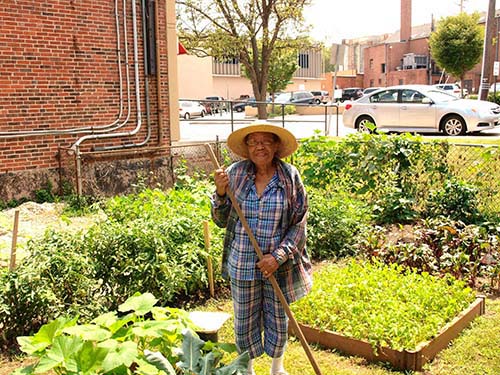
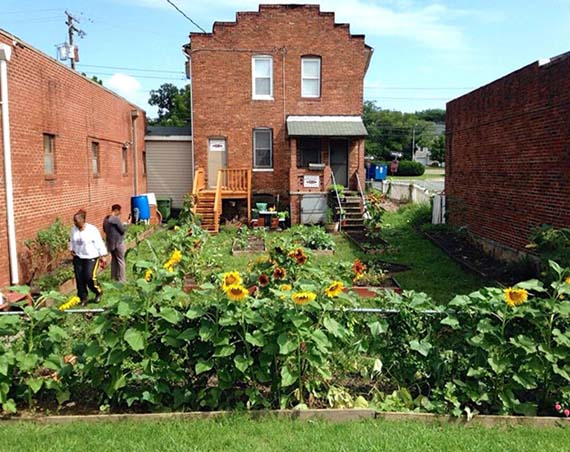
Church members pulled up the lawn and planted a garden, later named Maxine’s Garden after Maxine Nichols who provided much of the expertise and organization. Soon, the garden was producing more than a thousand pounds of produce for distribution each season and Rev. Brown was thinking about what a church-led community food system might look like. Five years later, in the wake of the uprisings in Baltimore City that followed the death of Freddie Gray in police custody, Brown founded the Black Church Food Security Network and began organizing a coalition of churches and farmers with the goal of sourcing produce from Black-owned farms and using Black churches as food distribution hubs. Today, the BCFSN has grown into an interdenominational network of more than two hundred affiliated churches.2
The Farms in the Black Church Food Security Network
Notes and Bibliography
- John T. Edge, “The Hidden Radicalism of Southern Food,” New York Times, May 7, 2017, L1; Monica M. White, Freedom Farmers: Agricultural Resistance and the Black Freedom Movement, University of California Press, 65. ↩︎
- Amy Frykholm, “Black Churches Tackle Food Insecurity,” Christian Century, November 18, 2020: 33-34. ↩︎